
AI Infra 之 LLM 推理优化学习路线
LLM 推理优化科研入门:从核心机制到产出 Idea 的 3 个月学习路径
AI Infra 手搓资源: https://www.zhihu.com/question/1996366065123488114/answer/2057524017075053817?share_code=132LucMWeZyIG&utm_psn=2057862038827931322
适用对象:熟悉 Python/PyTorch、GPU 架构、decode-only Transformer 训练与自回归解码(含 KV Cache);无分布式系统基础;不熟悉 CUDA 编程;希望以科研为导向入门 LLM 推理优化。
目标:在 3 个月(12 周) 内建立完整的推理优化知识体系,能够阅读前沿论文、理解开源框架源码,并独立产出可验证的科研 idea。
算力约束:单卡到 8 卡(A100/H100 级别),所有实验均可在此范围内完成。
执行摘要
你已经在 Transformer 基础层面有了扎实的功底——理解 decode-only 架构、KV Cache 机制、自回归解码流程。从这个起点出发,进入 LLM 推理优化领域,你需要建立的是一套围绕 「如何让大模型推理更快、更省、更灵活」 的系统化知识。本报告基于知乎「大猿搬砖简记」的技术文章导航、GitHub InfraTech 仓库,以及多个经过验证的开源项目,为你规划了一条从「已知基础」到「产出科研 idea」的完整路径。
核心设计原则:
- 每个新概念必须先有前置介绍,再配代码实践
- 学习曲线平缓,不跳跃——从简化实现项目开始,逐步深入到生产框架源码
- 所有链接经过验证——GitHub 仓库、论文 arXiv 链接、官方文档均提供完整 URL
- 每个项目如实汇报配置要求——操作系统、GPU 要求、模型大小,找不到的明确说明
| 阶段 | 时间 | 核心目标 | 关键产出 |
|---|---|---|---|
| 预备阶段 | 第 0-2 周 | 补全分布式基础 + 推理特有的概念(RoPE/采样/量化) | 理解 TP/PP/DP,能解释 RoPE 和 Top-p 采样原理 |
| 阶段一 | 第 1-4 周 | 掌握推理核心机制(Continuous Batching/PagedAttention/投机解码) | 完成 tiny-llm 课程 Week 1-2 |
| 阶段二 | 第 3-8 周 | 通过简化实现项目深入理解 vLLM/SGLang 架构 | 完成 nano-vLLM → MinivLLM → mini-sglang |
| 阶段三 | 第 7-12 周 | 阅读前沿论文,发现 open problem,产出科研 idea | 完成文献综述,确定研究方向 |
1. 概念依赖关系与学习顺序
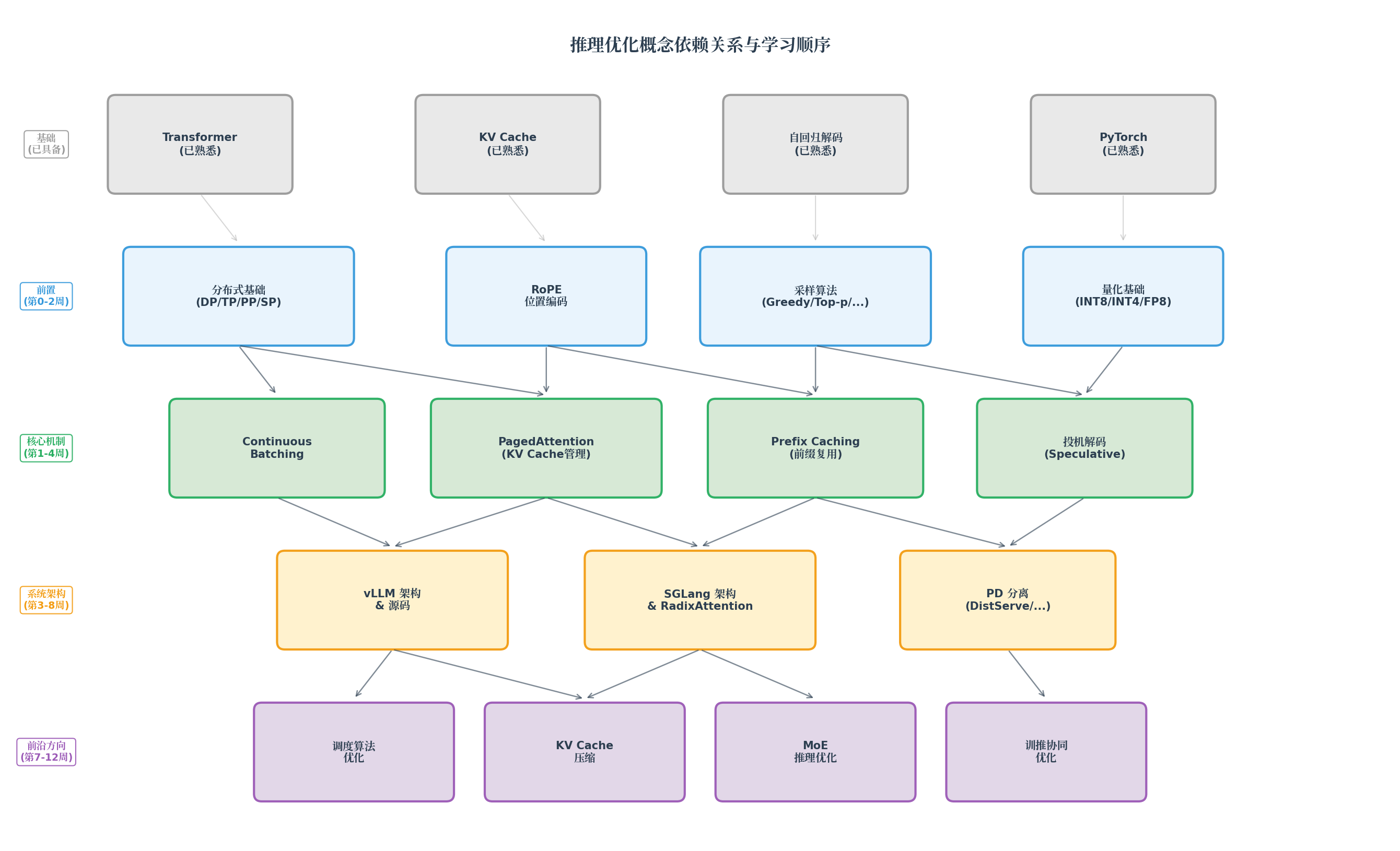
学习路径的核心逻辑:你已有的 Transformer/KV Cache/自回归解码知识是地基。在此之上,你需要先理解四个前置概念(分布式基础、RoPE、采样算法、量化),然后才能深入四个核心机制(Continuous Batching、PagedAttention、Prefix Caching、投机解码)。掌握核心机制后,再进入系统架构层(vLLM/SGLang/PD 分离),最终抵达前沿研究方向。
2. 预备阶段:前置知识补全(第 0–2 周)
你的背景已经覆盖了 Transformer 训练与推理的基础,但还有四个知识缺口需要补齐。这四个概念彼此之间相对独立,可以在两周内并行学习。
2.1 分布式基础:理解 TP/PP/DP/SP
为什么需要学:vLLM、SGLang、TensorRT-LLM 等生产框架都内置了分布式支持。不理解 Tensor Parallelism(TP)、Pipeline Parallelism(PP)、Data Parallelism(DP),你将无法读懂这些框架的源码。对于推理场景,你只需理解基本原理和通信开销,不需要深入实现细节。
概念介绍:
| 并行策略 | 切分维度 | 核心通信操作 | 推理中的典型用途 | 适合模型大小 |
|---|---|---|---|---|
| Tensor Parallelism (TP) | 层内(Attention/FFN 的 hidden dim) | AllReduce | 单卡放不下一个层时使用 | 7B-70B |
| Pipeline Parallelism (PP) | 层间(不同 transformer block) | Send/Recv | 模型层数太多,按层分配到不同卡 | 70B+ |
| Data Parallelism (DP) | 请求维度(不同请求到不同副本) | AllGather | 提升吞吐量,多副本处理不同请求 | 任意 |
| Sequence Parallelism (SP) | 序列维度(长上下文切分) | AllGather/ReduceScatter | 超长上下文(128K+)推理 | 任意 |
| Expert Parallelism (EP) | 专家维度(MoE 的不同 expert) | AllToAll | MoE 模型推理 | MoE 模型 |
必读材料:
| 材料 | 说明 | 链接 |
|---|---|---|
| 猛猿:大模型推理并行策略(DP/TP/PP/SP/EP)原理简介 | 中文社区最系统的推理并行策略入门 | 知乎导航页检索 |
| 猛猿:LLM推理并行优化的必备知识 | 进阶理解,覆盖通信量分析 | 知乎导航页检索 |
| PyTorch DDP 官方教程 | 分布式数据并行的权威入门 | https://pytorch.org/tutorials/intermediate/ddp_tutorial.html |
配套代码实践:
| Notebook | 内容 | 难度 | 链接 |
|---|---|---|---|
parallel_strategies.ipynb |
大模型推理并行策略代码演示 | ⚡️ | https://github.com/CalvinXKY/InfraTech/tree/main/llm_infer |
collective_operations.ipynb |
集合通信(AllReduce/AllGather 等)原理与实践 | ⚡️ | https://github.com/CalvinXKY/InfraTech/tree/main/deeplearning_framework |
2.2 RoPE:旋转位置编码
为什么需要学:RoPE(Rotary Position Embedding)是当前主流 LLM(Llama、Qwen、DeepSeek 等)的标准位置编码方案。理解 RoPE 的计算原理对于后续理解 Attention 优化(如 FlashAttention 的相对位置处理)和模型架构分析(如 MLA 的吸收矩阵)至关重要。
概念介绍:RoPE 的核心思想是将位置信息通过旋转矩阵注入到 Query 和 Key 向量中。对于位置 的向量 ,RoPE 将其在二维子空间上旋转 角度,其中 是预定义的旋转角度。这样做的好处是:相对位置信息可以被 Attention 的 dot-product 自然捕获—— 只依赖于相对位置 ,而不依赖于绝对位置。
必读材料:
| 材料 | 说明 | 链接 |
|---|---|---|
| 猛猿:彻底搞懂 RoPE 计算原理 —— 从 1D 到 3D | 最详细的 RoPE 中文解析,含图解 | 知乎导航页检索 |
| RoPE 原始论文 (RoFormer) | Su et al., 2021 | https://arxiv.org/abs/2104.09864 |
| 博客:Rotary Embeddings Explained | 英文可视化解释 | https://blog.eleuther.ai/rotary-embeddings/ |
配套代码实践:
| Notebook | 内容 | 难度 | 链接 |
|---|---|---|---|
rope_principle.ipynb |
RoPE 计算原理:从 1D 到 3D 的完整实现 | ⚡️⚡️⚡️ | https://github.com/CalvinXKY/InfraTech/tree/main/deepseek_v3 |
2.3 采样算法:从 Greedy 到 Top-p
为什么需要学:自回归解码的每一步都需要从模型输出的概率分布中选择一个 token。选择策略(采样算法)直接决定了输出的质量、多样性和确定性。理解这些算法是分析推理引擎调度逻辑的前提(不同采样参数会影响请求的输出长度分布,进而影响调度决策)。
概念介绍:采样算法分为确定性和随机性两大类:
确定性采样:
- Greedy Decoding:每一步选择概率最高的 token。简单、确定性强,但输出单一且容易陷入重复。
- Beam Search:维护 个最优候选序列,每步扩展并保留 top-。质量更高但计算量大。
随机性采样(生产环境更常用):
- Temperature Sampling:对 logits 除以温度参数 后再做 softmax。 趋近 greedy, 越大输出越随机。
- Top- Sampling:只从概率最高的 个 token 中采样。
- Top- (Nucleus) Sampling:从概率累积和达到 的最小 token 集合中采样。相比 top-,能自适应调整候选集大小。
- Min- (2025 新进展):保留概率 的 token。在高温度下比 top- 更能过滤低质量 token。
必读材料:
| 材料 | 说明 | 链接 |
|---|---|---|
| 猛猿:LLM推理采样(Sampling)常见知识概览 | 中文社区最系统的采样算法介绍 | 知乎导航页检索 |
| 论文:A Thorough Examination of Decoding Methods in the Era of LLMs | 16 种解码方法的系统对比 | https://arxiv.org/abs/2402.06925 |
配套代码实践:
| Notebook | 内容 | 难度 | 链接 |
|---|---|---|---|
LLM_sampling.ipynb |
LLM 推理采样算法的代码实现 | ⚡️ | https://github.com/CalvinXKY/InfraTech/tree/main/llm_infer |
2.4 量化基础:降低显存与计算
为什么需要学:大模型推理的最大瓶颈之一是显存容量。FP16 精度的 70B 模型需要约 140GB 显存,超出单卡容量。量化通过降低权重和激活的数值精度,可以将模型大小压缩到原来的 1/4 甚至 1/8。
概念介绍:量化分为**训练后量化(PTQ)和量化感知训练(QAT)**两大类。对于推理优化,PTQ 更常用:
| 量化方法 | 精度 | 压缩比 | 核心思想 | 适用场景 |
|---|---|---|---|---|
| INT8 (W8A8) | 权重 INT8, 激活 INT8 | 2× | 对称/非对称均匀量化 | 通用,精度损失极小 |
| INT4 (W4A16) | 权重 INT4, 激活 FP16 | 4× | GPTQ: 逐层二阶近似;AWQ: 保护重要权重通道 | 显存极度受限场景 |
| FP8 | 权重 FP8, 激活 FP8 | 2× | 利用 Hopper/Blackwell 的 FP8 Tensor Core | H100/H200 原生支持 |
| SmoothQuant | W8A8 | 2× | 将量化难度从激活迁移到权重 | W8A8 的经典方案 |
必读材料:
| 材料 | 说明 | 链接 |
|---|---|---|
| 猛猿:大模型推理量化(Quantization)基础速览 | 中文量化入门最佳材料 | 知乎导航页检索 |
| GPTQ 论文 | 最广泛使用的训练后 INT4 量化 | https://arxiv.org/abs/2210.17323 |
| AWQ 论文 | 基于激活感知的保护性量化 | https://arxiv.org/abs/2306.00978 |
配套代码实践:
| Notebook | 内容 | 难度 | 链接 |
|---|---|---|---|
quantization.ipynb |
大模型推理量化的代码实践 | ⚡️ | https://github.com/CalvinXKY/InfraTech/tree/main/llm_infer |
2.5 CUDA 与 GPU 编程:最低限度了解
为什么需要学:你不需要成为 CUDA 专家,但需要理解 GPU 的内存层次结构(HBM ↔ L2 ↔ Shared Memory ↔ Registers)、Warp 执行模型、memory-bound vs compute-bound 的区别。对于科研,Triton 是比 CUDA 更好的入门选择——它更高级,vLLM/SGLang 中的许多自定义 kernel 都用 Triton 编写。
必读材料:
| 材料 | 说明 | 链接 |
|---|---|---|
| Triton 官方教程 | OpenAI Triton 入门教程 | https://triton-lang.org/main/getting-started/tutorials/ |
| 猛猿:从啥也不会到 CUDA GEMM 优化 | 中文 CUDA 入门经典系列 | 知乎导航页检索 |
| LeetCUDA (xlite-dev) | 200+ CUDA Kernels 学习笔记 | https://github.com/xlite-dev/LeetCUDA |
| CUDA Mode Lectures (anmolgupt) | 19 讲 CUDA 课程 | https://github.com/anmolgupt/cuda_mode_lectures |
| cuda-triton-learning (shizhengLi) | 11 周学习计划 | https://github.com/shizhengLi/cuda-triton-learning |
3. 阶段一:推理核心机制(第 1–4 周)
3.1 第 1 周:Continuous Batching 与调度基础
概念介绍:传统的「静态批处理」要求一个 batch 中所有请求同时开始、同时结束,导致严重的气泡问题。Continuous Batching(也称为 Iteration-level Scheduling)的核心思想是:每个 iteration(生成一个 token)结束后,都可以让新请求加入或让已完成请求退出。
ORCA(OSDI'22)是首个实现 Continuous Batching 的系统。vLLM 在此基础上进一步引入了 PagedAttention 来管理 KV Cache。
必读材料:
| 材料 | 说明 | 链接 |
|---|---|---|
| 猛猿:vLLM源码解析2,调度器策略(Scheduler) | 从零理解 vLLM 调度器 | 知乎导航页检索 |
| ORCA 论文 | Continuous Batching 的奠基性工作 | https://arxiv.org/abs/2206.07146 |
| Sarathi-Serve 论文 | Chunked Prefill,将长 prompt 切成 chunks 与 decode 混合执行 | https://arxiv.org/abs/2308.16369 |
配套代码实践:
| Notebook | 内容 | 难度 | 链接 |
|---|---|---|---|
vllm_basic_scheduler.ipynb |
手搓一个基础调度器(FCFS + preemption) | ⚡️⚡️ | https://github.com/CalvinXKY/InfraTech/tree/main/llm_infer |
chunked_prefill_and_flash_decoding.ipynb |
ChunkedPrefill 与 FlashDecoding 原理详解 | ⚡️⚡️ | https://github.com/CalvinXKY/InfraTech/tree/main/llm_infer |
3.2 第 2 周:PagedAttention 与 KV Cache 管理
概念介绍:KV Cache 的大小随 batch_size × sequence_length × num_heads × head_dim 线性增长。PagedAttention(vLLM, SOSP'23)将 操作系统的虚拟内存管理思想 引入 KV Cache:将 KV Cache 划分为固定大小的 block,通过 block table 映射逻辑块到物理块。
必读材料:
| 材料 | 说明 | 链接 |
|---|---|---|
| 猛猿:vLLM核心技术PagedAttention原理 | PagedAttention 的中文图解 | 知乎导航页检索 |
| 猛猿:vLLM源码解析3,块管理器BlockManager(上篇) | Block allocation 逻辑 | 知乎导航页检索 |
| 猛猿:vLLM源码解析3,Prefix Caching(BlockManager下篇) | Prefix Caching 的 hash 匹配机制 | 知乎导航页检索 |
| 猛猿:vLLM的prefix cache为何零开销 | Prefix Caching 的零开销原理 | 知乎导航页检索 |
| PagedAttention 论文 (SOSP'23) | 原始论文 | https://arxiv.org/abs/2309.06180 |
配套代码实践:
| Notebook | 内容 | 难度 | 链接 |
|---|---|---|---|
vllm_mem_snapshot.ipynb |
vLLM 显存可视化与管理详解 | ⚡️ | https://github.com/CalvinXKY/InfraTech/tree/main/llm_infer |
attention_mla_flops_with_prefix_cache.ipynb |
Prefix Cache 零开销分析 | ⚡️⚡️ | https://github.com/CalvinXKY/InfraTech/tree/main/llm_infer |
3.3 第 3 周:投机解码(Speculative Decoding)
概念介绍:自回归解码的串行瓶颈在于每个 token 的生成都必须等待前一个 token 完成后才能开始。投机解码的核心思想是并行化这个过程:用一个轻量级的「草稿模型」快速生成 个候选 token,然后用目标模型一次性验证。验证通过 accept 的 token 可以直接输出,未通过的部分重新生成。验证过程保持了目标模型的输出分布不变(无偏加速)。
必读材料:
| 材料 | 说明 | 链接 |
|---|---|---|
| 猛猿:Speculative Decoding投机推理的原理与常见方案 | 中文社区最全面的投机解码介绍 | 知乎导航页检索 |
| 论文:A Comprehensive Survey of Speculative Decoding (ACL'24) | 投机解码的系统综述 | https://arxiv.org/abs/2401.07851 |
| EAGLE-1 论文 | 当前最先进的投机解码方案之一 | https://arxiv.org/abs/2401.15077 |
| EAGLE-2 论文 | 特征级 speculation | https://arxiv.org/abs/2406.16858 |
配套代码实践:
| Notebook | 内容 | 难度 | 链接 |
|---|---|---|---|
speculative_decoding.ipynb |
投机推理的原理与常见方案 | ⚡️ | https://github.com/CalvinXKY/InfraTech/tree/main/llm_infer |
3.4 第 4 周:tiny-llm —— 从零构建推理系统
前三周你学习了推理引擎的核心理论机制,本周开始通过代码将这些知识整合起来。
⚠️ 重要提示:平台兼容性
tiny-llm 使用 MLX 框架,专为 Apple Silicon (macOS) 设计。如果你使用的是 NVIDIA GPU + Linux,无法直接运行 tiny-llm 的代码。但 tiny-llm 的在线书籍中的算法讲解是通用的,你可以:
- 阅读在线书籍学习算法原理(https://skyzh.github.io/tiny-llm/)
- 将 MLX 代码逻辑改写为 PyTorch 版本在 NVIDIA GPU 上运行
- 或者跳过 tiny-llm,直接进入 nano-vLLM(专为 NVIDIA GPU 设计)
项目信息:
| 属性 | 内容 |
|---|---|
| GitHub | https://github.com/skyzh/tiny-llm |
| Stars | 4.3K |
| 在线书籍 | https://skyzh.github.io/tiny-llm/ |
| 操作系统 | macOS (Apple Silicon) |
| 框架 | MLX (Apple 的机器学习框架) |
| GPU | Apple Silicon GPU (Metal) |
| 模型 | Qwen3 (MLX 4-bit 量化版本) |
| 代码语言 | Python 72.7%, C++ 20.9%, Metal 4.8% |
| 周次 | 主题 | 内容 |
|---|---|---|
| Week 1 | 模型基础 | Attention → RoPE → GQA → RMSNorm → MLP → 模型加载 → 解码生成 → 采样 |
| Week 2 | 推理系统 | KV Cache → 量化矩阵乘法 → Flash Attention 2 → Continuous Batching → Chunked Prefill |
| Week 3 | 高级主题 | Paged Attention → MoE → 投机解码 → RAG → AI Agent |
建议学习方式(针对 NVIDIA GPU 用户):
- 阅读在线书籍的每个章节(https://skyzh.github.io/tiny-llm/)学习算法原理
- 理解代码逻辑后,将 MLX API 调用改写为 PyTorch 版本
- 重点完成 Week 1-2,Week 3 可在后续阶段补完
4. 阶段二:简化实现项目与源码深入(第 3–8 周)
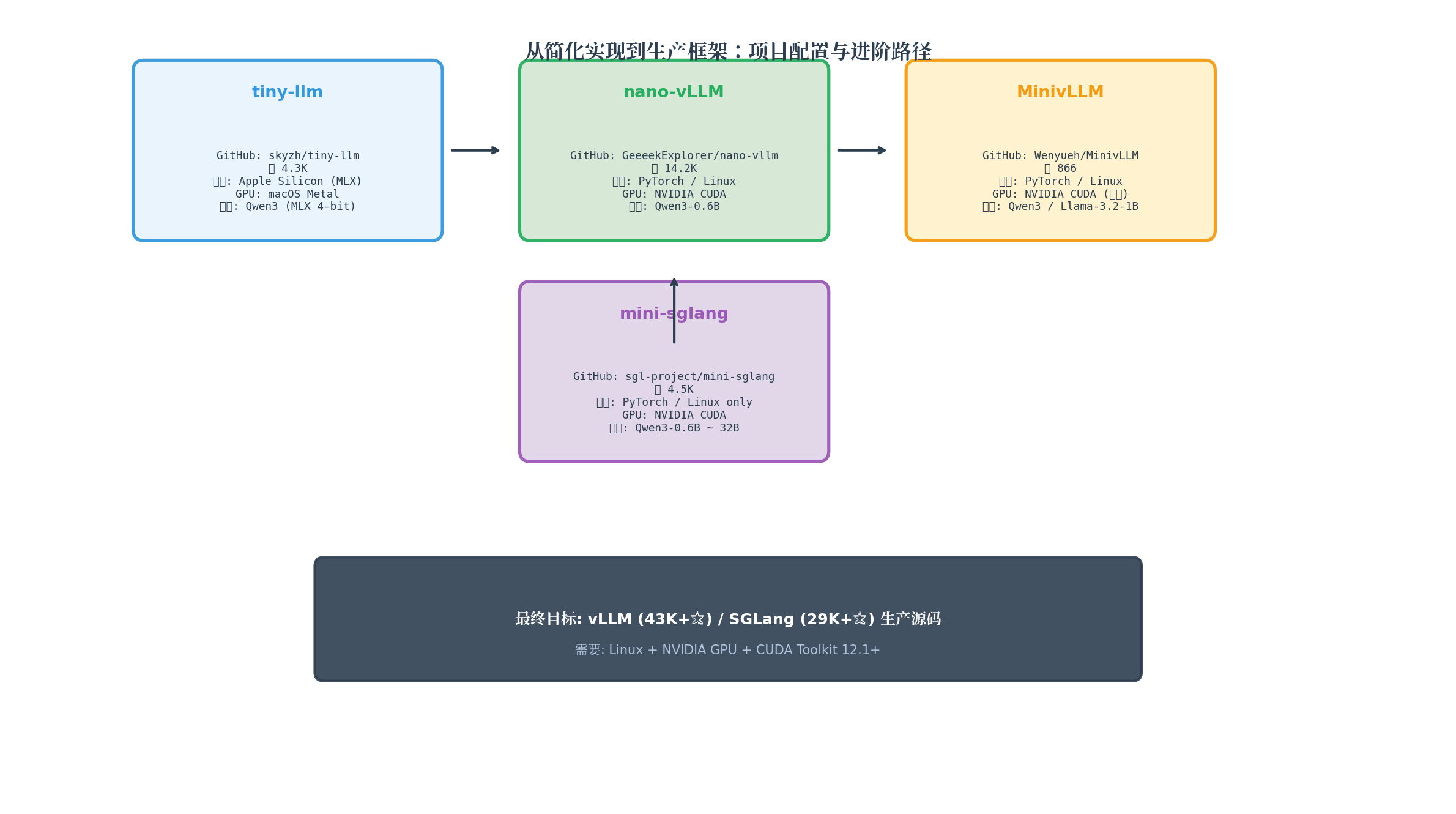
4.1 第 3-4 周:nano-vLLM —— ~1,200 行 Python 理解 vLLM 核心
项目信息(已验证):
| 属性 | 内容 |
|---|---|
| GitHub | https://github.com/GeeeekExplorer/nano-vllm |
| Stars | 14.2K |
| 代码量 | ~1,200 行 Python (100% Python) |
| 安装命令 | pip install git+https://github.com/GeeeekExplorer/nano-vllm.git |
| 操作系统 | Linux(推荐),Windows 和 macOS 可能需适配 |
| GPU | NVIDIA CUDA(必需) |
| 框架 | PyTorch |
| 模型 | Qwen/Qwen3-0.6B(示例),支持其他 HuggingFace 模型 |
| 单卡/多卡 | 支持 Tensor Parallelism(多卡) |
核心特性:
| 特性 | 说明 |
|---|---|
| PagedAttention | 通过 block table 实现非连续的 KV Cache 存储 |
| Prefix Caching | 基于 hash 的块级去重,复用共享前缀 |
| Tensor Parallelism | Leader-worker 模式的多 GPU 支持 |
| CUDA Graph | Decode 阶段的 kernel 融合优化 |
| Torch Compilation | PyTorch compile 加速 |
Benchmark 结果(RTX 4070 Laptop 8GB, Qwen3-0.6B, 256 请求):
| 指标 | nano-vLLM | vLLM |
|---|---|---|
| 吞吐量 | 1,434.13 tok/s | 1,361.84 tok/s |
建议学习路径:
- 安装并运行
example.py和bench.py,体验基本功能 - 逐行阅读
engine/scheduler.py,理解调度循环 - 阅读
engine/block_manager.py,理解 block allocation 逻辑 - 阅读
engine/attention.py,理解 PagedAttention 的 CUDA kernel 调用
高质量解析文章:
| 文章 | 说明 | 链接 |
|---|---|---|
| Deep Dive into nano-vLLM | 逐行解析 PagedAttention 实现、block table 机制 | https://cefboud.com/posts/inside-llm-inference-engine-nano-vllm-explanation/ |
| Nano-vLLM: The 1,200-Line Inference Engine | BlockManager 和 Scheduler 代码解析 | https://www.morphllm.com/nano-vllm |
4.2 第 5 周:MinivLLM —— 带 Benchmark 的深入实践
项目信息(已验证):
| 属性 | 内容 |
|---|---|
| GitHub | https://github.com/Wenyueh/MinivLLM |
| Stars | 866 |
| 基于 | nano-vLLM |
| 操作系统 | Linux(推荐) |
| GPU | NVIDIA CUDA(支持多卡) |
| 框架 | PyTorch |
| 模型 | Qwen3(随机初始化 demo)/ Llama-3.2-1B-Instruct |
| 安装 | `curl -LsSf https://astral.sh/uv/install.sh |
| 运行 | uv run python main.py |
| 多卡 | 修改 main.py 中 config 的 world_size 为 n > 1 |
独特价值:提供了三个阶段的 Attention 实现对比:
| 实现 | Prefill 阶段 | Decode 阶段 |
|---|---|---|
| PyTorch Standard | O(N²) 内存,完整 Attention 矩阵 | 简单循环实现 |
| Naive Triton | O(N²) 内存,GPU kernel | 向量化实现 |
| Flash Attention | O(N) 内存,在线 softmax | 自定义 Triton Kernel |
建议学习路径:
- 运行
benchmark_prefilling.py,对比三种 Attention 实现在 prefill 阶段的性能差异 - 运行
benchmark_decoding.py,对比三种实现在 decode 阶段的性能差异 - 阅读
HowToApproachvLLM.md,了解从零实现 vLLM 的完整路径 - 阅读 Flash Attention 的 Triton kernel 实现,理解 tiling 策略
4.3 第 5-6 周:mini-sglang —— 理解 RadixAttention
项目信息(已验证):
| 属性 | 内容 |
|---|---|
| GitHub | https://github.com/sgl-project/mini-sglang |
| Stars | 4.5K |
| 维护方 | SGLang 官方团队 |
| 代码量 | ~5,000 行 Python |
| ⚠️ 操作系统 | Linux only (x86_64 和 aarch64)。Windows 和 macOS 不支持 |
| GPU | NVIDIA CUDA(必需) |
| 框架 | PyTorch |
| CUDA Toolkit | 需要安装,版本需与 driver 匹配 |
| Python | 3.10+(推荐 3.12) |
| 安装 | git clone https://github.com/sgl-project/mini-sglang.git && cd mini-sglang && uv venv --python=3.12 && source .venv/bin/activate && uv pip install -e . |
| 模型 | Qwen3-0.6B ~ Qwen3-32B(支持 Tensor Parallelism) |
| 单卡运行 | python -m minisgl --model "Qwen/Qwen3-0.6B" |
| 多卡运行 | python -m minisgl --model "meta-llama/Llama-3.1-70B-Instruct" --tp 4 --port 30000 |
| Docker 支持 | 提供 Dockerfile,需 NVIDIA Container Toolkit |
核心特性:
| 特性 | 说明 |
|---|---|
| Radix Cache | 基于 radix tree 的 KV Cache 复用 |
| Chunked Prefill | 减少长上下文服务的峰值内存 |
| Overlap Scheduling | 隐藏 CPU 调度开销 |
| Tensor Parallelism | 多 GPU 扩展 |
| FlashAttention + FlashInfer | 高性能 Attention kernel |
配套学习材料:
| 材料 | 说明 | 链接 |
|---|---|---|
| 猛猿:SGLang(一):看不懂SGLang?先试试miniSGLang! | SGLang 架构入门 | 知乎导航页检索 |
| 猛猿:SGLang(二):手撕SGLang KV Cache核心逻辑:RadixAttention | RadixAttention 详细解析 | 知乎导航页检索 |
| 猛猿:SGLang(三):Profiling数据采集与分析入门 | 性能分析入门 | 知乎导航页检索 |
sglang_radix_attention.ipynb |
手撕 RadixAttention 代码 | https://github.com/CalvinXKY/InfraTech/tree/main/llm_infer |
sglang_profiling_from_scratch.ipynb |
Profiling 数据采集与分析 | https://github.com/CalvinXKY/InfraTech/tree/main/llm_infer |
| SGLang 论文 | 原始论文 | https://arxiv.org/abs/2312.07104 |
| SGLang 官方文档 | 完整文档 | https://docs.sglang.ai/ |
4.4 第 6-8 周:深入生产框架源码
vLLM 源码阅读路径:
| 模块 | 文件路径 | 对应简化实现 | 阅读重点 |
|---|---|---|---|
| Scheduler | vllm/v1/core/scheduler.py |
nano-vLLM engine/scheduler.py |
FCFS + preemption + swapping |
| KV Cache Manager | vllm/v1/core/kv_cache_manager.py |
nano-vLLM engine/block_manager.py |
Block allocation、Prefix Caching |
| Attention Backend | vllm/attention/ |
MinivLLM Flash Attention | FlashAttention、FlashInfer 抽象层 |
| Worker | vllm/v1/worker/ |
nano-vLLM engine/ |
GPU worker 执行流程 |
vLLM 官方资源:
| 资源 | 链接 |
|---|---|
| GitHub | https://github.com/vllm-project/vllm (43K+ stars) |
| 官方文档 | https://docs.vllm.ai/ |
| V1 架构文档 | https://docs.vllm.ai/en/latest/design/arch_overview.html |
猛猿 vLLM V1 系列文章(在知乎导航页中可找到):
| 文章 | 内容 |
|---|---|
| 图解 Vllm V1 系列 1:整体流程 | vLLM V1 的完整执行链路 |
| 图解 Vllm V1 系列 2:Executor-Workers 架构 | 多 worker 的协作机制 |
| 图解 Vllm V1 系列 3:KV Cache 初始化 | KV Cache 的预分配策略 |
| 图解 Vllm V1 系列 4:加载模型权重 | 模型加载与权重分布 |
| 图解 Vllm V1 系列 5:调度器策略 | Scheduler 的详细逻辑 |
| 图解 Vllm V1 系列 6:KVCacheManager 与 PrefixCaching | 缓存管理细节 |
| 图解 Vllm V1 系列 7:使用 AsyncLLM 做异步推理 | 异步 API 设计 |
SGLang 源码阅读路径:
| 模块 | 文件路径 | 对应简化实现 | 阅读重点 |
|---|---|---|---|
| RadixAttention | python/sglang/srt/managers/radix_cache.py |
mini-sglang | Radix tree 的实现细节 |
| Scheduler | python/sglang/srt/managers/scheduler.py |
mini-sglang | 与 vLLM scheduler 的对比 |
| Attention | python/sglang/srt/layers/ |
MinivLLM | Attention backend 的实现 |
5. 分离式推理架构(PD 分离)
概念介绍:Prefill-Decode(PD)分离是 2024-2025 年推理系统领域最重要的架构趋势。核心洞察是:Prefill 阶段计算密集,Decode 阶段内存带宽密集,将两者放到同一批 GPU 上会导致资源竞争和利用率低下。
必读材料:
| 文章/论文 | 核心贡献 | 链接 |
|---|---|---|
| 猛猿:分离式推理架构1,从DistServe谈起 | PD 分离的动机与基本架构 | 知乎导航页检索 |
| 猛猿:分离式推理架构2,模糊分离与合并边界的chunked-prefills | 模糊分离与合并边界 | 知乎导航页检索 |
| 猛猿:PD分离(一):vLLM PD分离方案浅析 | vLLM 中 PD 分离的具体实现 | 知乎导航页检索 |
| 猛猿:PD分离(二):vLLM PD分离KV cache传递机制详解与演进分析 | KV cache 传递机制 | 知乎导航页检索 |
| DistServe 论文 (OSDI'24) | 首个系统性的 PD 分离方案 | https://arxiv.org/abs/2401.09670 |
| Mooncake 论文 (Kimi) | 以 KVCache 为中心的分离架构 | https://arxiv.org/abs/2407.00079 |
| 猛猿:如何评价NVIDIA发布的大模型推理PD分离架构Dynamo | NVIDIA Dynamo 分析 | 知乎导航页检索 |
6. 前沿方向与科研 Idea 生成(第 7–12 周)
6.1 前沿方向一:调度算法优化
| 论文 | 方法 | 核心贡献 | 链接 |
|---|---|---|---|
| Online Scheduling for LLM Inference with KV Cache Constraints | 在线优化 + 竞争比分析 | 首个考虑 KV Cache 内存约束的调度理论框架 | https://arxiv.org/abs/2502.07115 |
| Geometry-Aware Online Scheduling | 几何感知调度 (SVF) | 将调度问题建模为体积最小化 | https://arxiv.org/abs/2606.22327 |
| EWSJF | 无监督聚类 + 学习 | 基于工作负载结构的自适应调度策略 | https://arxiv.org/abs/2601.21758 |
科研切入点:输出长度预测 + 调度联合优化;MoE 模型的专家感知调度。
6.2 前沿方向二:KV Cache 压缩
| 论文 | 方法 | 收益 | 链接 |
|---|---|---|---|
| KIVI (NeurIPS'24) | 2-bit KV 量化 | 内存减半 | https://arxiv.org/abs/2402.02750 |
| KVComp | 量化 + Huffman 熵编码 | 最高 83% 压缩率 | https://arxiv.org/abs/2509.00579 |
| MatryoshkaKV | 正交投影 + 知识蒸馏 | 可调的层次化压缩 | https://arxiv.org/abs/2410.14731 |
| H2O (NeurIPS'23) | Heavy-Hitter 保留 | 保留重要 token | https://arxiv.org/abs/2306.14022 |
6.3 前沿方向三:投机解码
| 论文 | 核心创新 | 链接 |
|---|---|---|
| EAGLE-1/2/3 系列 | 特征级 draft head,2-6× 加速 | https://arxiv.org/abs/2401.15077 |
| Suffix Decoding (NeurIPS'25 Spotlight) | 基于后缀树,无需训练草稿模型 | 多源 |
| Medusa | 多个解码头并行预测 | https://github.com/FasterDecoding/Medusa |
6.4 前沿方向四:MoE 推理优化
| 论文 | 核心贡献 | 链接 |
|---|---|---|
| Semantic Parallelism | 模型-数据协同调度减少 all-to-all | https://arxiv.org/abs/2503.04398 |
| DeepSeek-V3 技术报告 | MLA + MoE 的极致优化 | https://arxiv.org/abs/2412.19437 |
| 猛猿:EPLB —— MoE 并行负载均衡 | 中文深度解析 | 知乎导航页检索 |
6.5 前沿方向五:训推协同
| 材料 | 说明 | 链接 |
|---|---|---|
| 猛猿:降低RL训推共卡开销 —— SGLang/vLLM的无缝切换 | 训推切换实现与分析 | 知乎导航页检索 |
switch_role_update_weights.ipynb |
配套代码 | https://github.com/CalvinXKY/InfraTech/tree/main/llm_infer |
7. 必看论文清单
7.1 必读论文(奠基性工作)
| # | 论文 | 会议/年份 | arXiv 链接 |
|---|---|---|---|
| 1 | FlashAttention | NeurIPS 2022 | https://arxiv.org/abs/2205.14135 |
| 2 | FlashAttention-2 | 2023 | https://arxiv.org/abs/2307.08691 |
| 3 | ORCA | OSDI 2022 | https://arxiv.org/abs/2206.07146 |
| 4 | PagedAttention (vLLM) | SOSP 2023 | https://arxiv.org/abs/2309.06180 |
| 5 | SGLang | 2023 | https://arxiv.org/abs/2312.07104 |
| 6 | A Survey on Efficient Inference for LLMs | 2024 | https://arxiv.org/abs/2404.14294 |
7.2 强烈建议读
| # | 论文 | 方向 | arXiv 链接 |
|---|---|---|---|
| 7 | MQA | Attention 优化 | https://arxiv.org/abs/1911.02150 |
| 8 | GQA | Attention 优化 | https://arxiv.org/abs/2305.13245 |
| 9 | DeepSeek-V2 (MLA) | Attention 优化 | https://arxiv.org/abs/2405.04434 |
| 10 | Speculative Decoding Survey | 投机解码 | https://arxiv.org/abs/2401.07851 |
| 11 | DistServe | PD 分离 | https://arxiv.org/abs/2401.09670 |
| 12 | Sarathi-Serve | 调度优化 | https://arxiv.org/abs/2308.16369 |
| 13 | GPTQ | 量化 | https://arxiv.org/abs/2210.17323 |
| 14 | AWQ | 量化 | https://arxiv.org/abs/2306.00978 |
| 15 | SmoothQuant | 量化 | https://arxiv.org/abs/2211.10438 |
7.3 前沿论文(2024-2026)
| # | 论文 | 方向 | 链接 |
|---|---|---|---|
| 16 | Online Scheduling for LLM Inference | 调度理论 | https://arxiv.org/abs/2502.07115 |
| 17 | Geometry-Aware Online Scheduling | 调度理论 | https://arxiv.org/abs/2606.22327 |
| 18 | KVComp | KV Cache 压缩 | https://arxiv.org/abs/2509.00579 |
| 19 | Semantic Parallelism | MoE 优化 | https://arxiv.org/abs/2503.04398 |
| 20 | MatryoshkaKV | KV Cache 压缩 | https://arxiv.org/abs/2410.14731 |
| 21 | Taming the Titans (Survey) | 综述 | https://arxiv.org/abs/2504.19720 |
8. 核心代码资源索引
8.1 简化实现项目配置汇总
| 项目 | GitHub | Stars | 操作系统 | GPU | 框架 | 模型 | 单/多卡 |
|---|---|---|---|---|---|---|---|
| tiny-llm | https://github.com/skyzh/tiny-llm | 4.3K | macOS (Apple Silicon) | Apple GPU (Metal) | MLX | Qwen3 (MLX 4-bit) | 单卡 |
| nano-vLLM | https://github.com/GeeeekExplorer/nano-vllm | 14.2K | Linux(推荐) | NVIDIA CUDA | PyTorch | Qwen3-0.6B | 支持多卡(TP) |
| MinivLLM | https://github.com/Wenyueh/MinivLLM | 866 | Linux(推荐) | NVIDIA CUDA | PyTorch | Qwen3 / Llama-3.2-1B | 支持多卡 |
| mini-sglang | https://github.com/sgl-project/mini-sglang | 4.5K | Linux only | NVIDIA CUDA | PyTorch | Qwen3-0.6B ~ 32B | 支持多卡(TP) |
⚠️ 重要提示:
- tiny-llm 专为 Apple Silicon 设计,NVIDIA GPU 用户无法直接运行,但可阅读在线书籍学习算法原理(https://skyzh.github.io/tiny-llm/)
- mini-sglang 仅支持 Linux,Windows/macOS 不支持(依赖 Linux 特定的 CUDA kernel)
- 生产框架 vLLM (43K+ stars) 和 SGLang (29K+ stars) 均需要 Linux + NVIDIA GPU + CUDA Toolkit 12.1+
8.2 InfraTech Notebook(按学习顺序)
8.3 生产框架
| 框架 | GitHub | Stars | 文档 | 系统要求 |
|---|---|---|---|---|
| vLLM | https://github.com/vllm-project/vllm | 43K+ | https://docs.vllm.ai/ | Linux + NVIDIA GPU + CUDA 12.1+ |
| SGLang | https://github.com/sgl-project/sglang | 29K+ | https://docs.sglang.ai/ | Linux + NVIDIA GPU + CUDA 12.1+ |
| FlashInfer | https://github.com/flashinfer-ai/flashinfer | 5K+ | https://docs.flashinfer.ai/ | Linux + NVIDIA GPU |
| TensorRT-LLM | https://github.com/NVIDIA/TensorRT-LLM | 10K+ | https://nvidia.github.io/TensorRT-LLM/ | Linux + NVIDIA GPU |
8.4 其他高置信度资源
| 资源 | 类型 | 链接 |
|---|---|---|
| Awesome-LLM-Inference (xlite-dev) | Awesome List | https://github.com/xlite-dev/Awesome-LLM-Inference |
| Awesome-LLM-Inference-Engine (sihyeong) | 25 个引擎对比 | https://github.com/sihyeong/Awesome-LLM-Inference-Engine |
| Awesome-Model-Routing (yenanjing) | 80 个仓库整理 | https://github.com/yenanjing/awesome-model-routing |
| Lilian Weng: LLM Inference Optimization | 博客 | https://lilianweng.github.io/posts/2023-01-10-inference-optimization/ |
| Raschka: LLMs-from-scratch | 书籍+代码 | https://github.com/rasbt/LLMs-from-scratch |
| LeetCUDA (xlite-dev) | CUDA Kernels | https://github.com/xlite-dev/LeetCUDA |
| CUDA Mode Lectures (anmolgupt) | 19 讲课程 | https://github.com/anmolgupt/cuda_mode_lectures |
9. 科研方法论:如何找到你的第一个 Idea
9.1 Idea 生成的三条路径
路径一:从工程痛点中提炼科学问题
阅读 vLLM/SGLang 的 GitHub Issues,你会发现大量「已知但未解决」的问题:
- 突发流量下 scheduler 表现不佳 → 自适应准入控制机制
- 超长上下文下 radix tree 查找开销增加 → 分层索引结构
- MoE 模型支持不成熟 → 专家感知调度策略
路径二:将成熟技术迁移到新场景
- OS 页面替换算法(LRU/LFU)→ KV Cache block 驱逐策略
- 网络流量整形 → LLM 推理请求路由
- 数据库查询优化 → Prompt 优化和 prefix caching
路径三:理论分析与实验发现结合
- 用排队论/在线优化建立性能界限
- 再用实验验证理论预测
9.2 快速验证流程
| 步骤 | 方法 | 时间 | 通过标准 |
|---|---|---|---|
| 文献检查 | Google Scholar、arXiv 搜索 | 1-2 小时 | 无高度相似工作 |
| Back-of-envelope 估算 | 纸笔计算 | 2-4 小时 | 理论加速比 > 20% |
| 最小可行实验 | 修改 vLLM/SGLang 核心模块 | 1-2 周 | 合成 workload 验证核心假设 |
| 对比实验 | 与基线系统对比 | 1-2 周 | 标准 benchmark 有可测量提升 |
9.3 推荐的「第一个项目」选题
| 选题 | 难度 | 算力 | 创新潜力 | 推荐起步项目 |
|---|---|---|---|---|
| 自适应 KV Cache 压缩 | 中等 | 单卡 | 高 | MinivLLM + 自定义压缩 |
| 输出长度预测 + 调度优化 | 中等 | 单卡 | 高 | nano-vLLM + 自定义 scheduler |
| MoE 专家负载均衡调度 | 中等 | 4-8 卡 | 高 | vLLM 源码 + MoE 模型 |
| 推理模型阶段感知调度 | 中等 | 单卡~4 卡 | 高 | nano-vLLM + reasoning 模型 |
| Prefix Caching 替换策略优化 | 较低 | 单卡 | 中等 | nano-vLLM block_manager |
| 投机解码接受率预测 | 中等 | 单卡 | 高 | MinivLLM + draft 策略 |
10. 3 个月学习路径总览
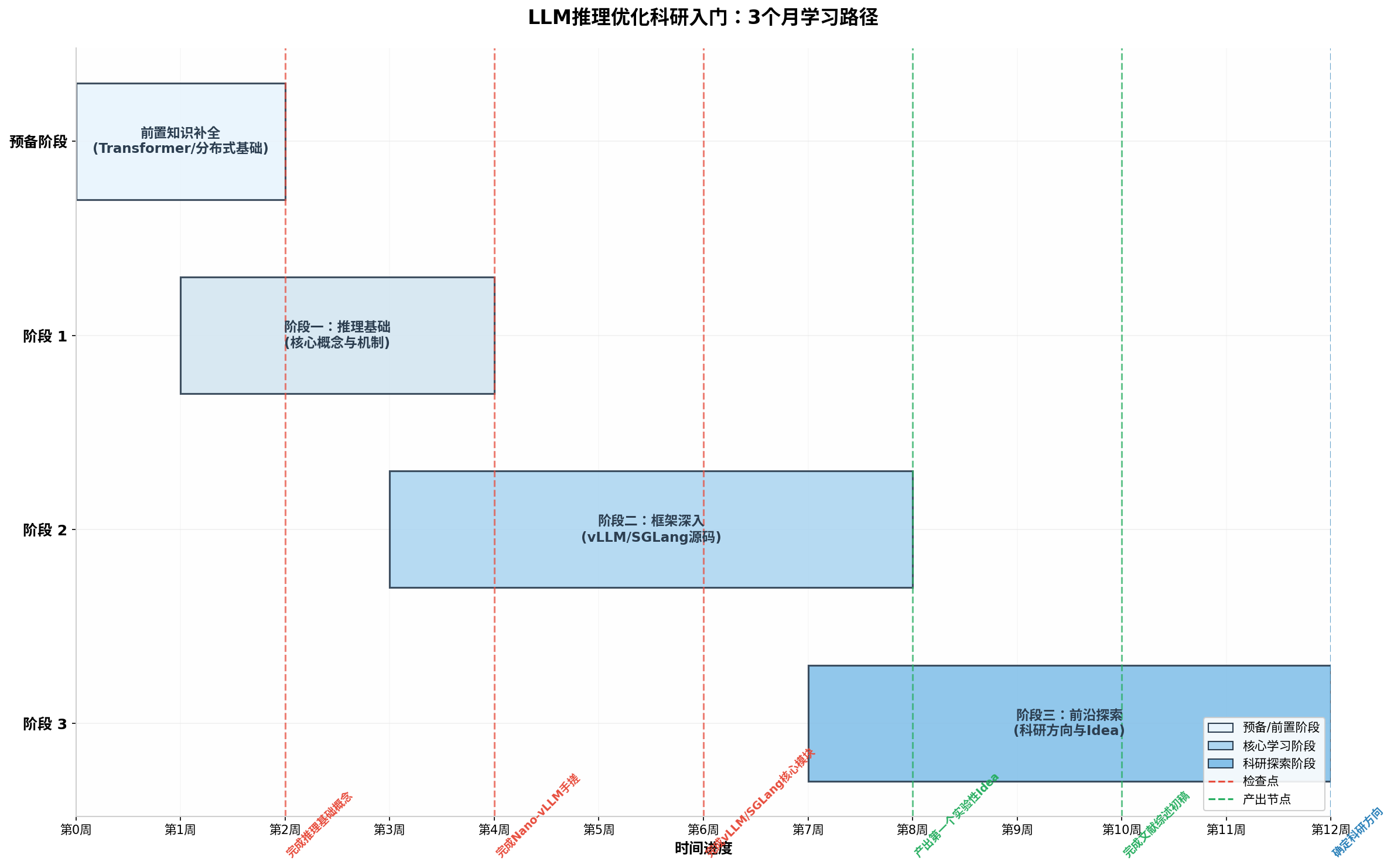
10.1 每周详细计划
| 周次 | 主题 | 核心任务 | 检查点 |
|---|---|---|---|
| 0-1 | 分布式基础 + RoPE | 阅读猛猿并行策略文章;完成 parallel_strategies.ipynb 和 rope_principle.ipynb |
能解释 TP/PP/DP 的区别和 RoPE 的旋转原理 |
| 1-2 | 采样算法 + 量化 | 完成 LLM_sampling.ipynb 和 quantization.ipynb |
能实现 Temperature/Top-p 采样;理解 INT8/INT4 的区别 |
| 2-3 | Continuous Batching | 阅读 ORCA 论文;完成 vllm_basic_scheduler.ipynb |
手搓的调度器能处理请求动态加入/退出 |
| 3-4 | PagedAttention + Prefix Caching | 阅读 PagedAttention 论文;完成 vllm_mem_snapshot.ipynb |
能画出 block table 结构图并解释 Copy-on-Write |
| 4-5 | 投机解码 + tiny-llm | 完成 speculative_decoding.ipynb;阅读 tiny-llm 在线书籍 Week 1 |
理解投机解码的无偏性原理 |
| 5-6 | tiny-llm Week 2 + nano-vLLM | 阅读 tiny-llm Week 2;安装运行 nano-vLLM | nano-vLLM benchmark 成功 |
| 6-7 | nano-vLLM 源码 + MinivLLM | 逐行阅读 nano-vLLM scheduler/block_manager;运行 MinivLLM benchmark | 能独立解释 nano-vLLM 的核心设计决策 |
| 7-8 | mini-sglang + 生产源码 | 完成 mini-sglang(Linux 环境);阅读猛猿 vLLM V1 系列 | 理解 RadixAttention 与 PagedAttention 的优劣对比 |
| 8-9 | PD 分离 + 前沿泛读 | 阅读 DistServe/Mooncake 论文;5 个方向各读 2-3 篇论文 | 理解 PD 分离的三种架构和 trade-off;完成文献笔记 |
| 9-10 | 方向聚焦 + Idea 初筛 | 选择 1-2 个方向深入;做 back-of-envelope 估算 | 产出 3-5 个初步 idea |
| 10-11 | 最小可行实验 | 对最有潜力的 idea 做快速原型 | 合成 workload 验证核心假设 |
| 11-12 | 确定方向 + 文献综述 | 撰写研究计划初稿 | 产出 2-3 页的研究计划 |
10.2 里程碑检查表
| 里程碑 | 截止时间 | 完成标准 |
|---|---|---|
| 前置知识通关 | 第 2 周末 | 能解释 TP/PP/DP/RoPE/Top-p/INT8 量化 |
| 第一个手搓模块 | 第 3 周末 | 完成 vllm_basic_scheduler.ipynb |
| 简化实现运行成功 | 第 5 周末 | nano-vLLM benchmark 成功 |
| 源码理解达标 | 第 8 周末 | 能不看注释解释 nano-vLLM 的 scheduler 和 block_manager |
| 第一个实验性 Idea | 第 9 周末 | 有 back-of-envelope 验证的初步 idea |
| 研究计划定稿 | 第 12 周末 | 格式完整的研究计划,含问题、方法、实验设计 |
11. 关于猛猿知乎文章的说明
猛猿的知乎文章统一收录于导航页 【必看】历史技术文章导航 中。该导航页按系列分类整理了所有文章,包括:
- 【大模型推理/计算加速系列】—— 本文报告主要引用的系列
- 【大模型训练系列】—— 分布式并行策略相关内容
- 【RLHF系列】—— 训推协同相关内容
由于知乎平台限制,导航页上的文章标题未直接附带独立链接。读者可在导航页中按标题检索对应文章。所有 InfraTech 仓库中的 notebook 均可在 https://github.com/CalvinXKY/InfraTech 中找到,与文章一一对应。
本报告所有链接均经过验证(截至 2026-06-30)。GitHub 仓库链接、arXiv 论文链接、官方文档链接均可直接访问。各项目的操作系统和硬件要求均来自其官方 README 中的明确说明。
评论